But This I Call To Mind

Lamentations 3:18–24

“So I say, ‘My endurance has perished; so has my hope from the Lord.’ Remember my affliction and my wanderings, the wormwood and the gall! My soul continually remembers it and is bowed down within me. But this I call to mind, and therefore I have hope: The steadfast love of the Lord never ceases; His mercies never come to an end; they are new every morning; great is Your faithfulness. ‘The Lord is my portion,’ says my soul, ‘therefore I will hope in Him.’”

I have spoken to many women lately, all who seem to say with one breath, “My endurance is perishing.” They lament that they are feeling close to the line of surrendering to sadness, grief, forlornness, loneliness, anger, betrayal, disappointment, and weariness.

We have moved from the society of saying, “I am fine,” to a place of brutal honesty about earthly life. And I think there is something good about that honesty. We don’t have to pretend that life doesn’t hurt. We don’t have to pretend that we aren’t tired, grieving, disappointed, lonely, or struggling. Lamentations certainly doesn’t pretend. The writer openly remembers his affliction, his wandering, the bitterness he has experienced, and how his soul is bowed down within him.

But this I call to mind, and therefore I have hope.

That “but” changes the direction of the entire passage. The circumstances didn’t necessarily change in that moment. The grief didn’t suddenly disappear. The disappointment wasn’t immediately resolved. The weariness was still real. But the writer chose what he would call to mind. He reminded himself of what was also true: the steadfast love of the Lord never ceases; His mercies never come to an end; they are new every morning; great is His faithfulness.

I think that is something many of us need to remember in the seasons when our endurance feels like it is perishing. We can be honest about how we feel without allowing our feelings to become the final truth. We can acknowledge the sadness, grief, loneliness, anger, betrayal, disappointment, and weariness while still remembering the character and faithfulness of God.

This life will lead us to eternal life when our hope is in Jesus, the Everlasting Father and Prince of Peace. He is our salvation and our Rock. He lifts us up when we have lost our strength and carries us through the places where we simply don’t have enough strength of our own. Our hope is in Jesus, the lifter of our heads and the healer of our souls.

View of sparkling ocean water with waves splashing in the foreground and a bright blue sky above.

This verse was shared with me this morning, and it was such a great daily reminder that the Lord is with us. We are not walking through this alone. He has gone before us, and He is with us. He is with you.

I encourage you today: The Lord is with you. He is for you. He has not forsaken you. He will see you through whatever it is you are struggling with, even if sometimes it feels like you only have enough strength to make it through today.

Maybe that is part of what it means for the Lord to be our portion. We don’t have to have tomorrow’s strength today. We don’t have to figure out the entire journey today. We simply have to trust Him with the portion He has given us for this day.

“This is my portion,” says my soul, “therefore I will hope in Him.”

So today, I will remember His faithfulness. Today, I will remember His mercy. Today, I will remember that He is with me. My worry for tomorrow does not belong to today.

This portion of Lamentations is enough for today. And if today is all I can manage, then today is enough.

Because His mercies are new every morning.

And tomorrow, there will be new mercy waiting for me there, too.

Great is Thy faithfulness.
Choosing Intentionality: A Word to Guide 2026

I entered the new year without a word, as I often do. But the same day I mapped out my annual January plan for fasting, prayer, and how I wanted 2026 to begin, it came to me with a quiet clarity—sudden in recognition, yet steady in its conviction: Intentionality.

This isn’t about doing more, being busier, or cramming my schedule full. It’s about living with purpose, heart, and presence in every part of life—about truly inhabiting each moment instead of letting it slip by or rushing ahead before it’s fully lived.

It’s about family: being intentional with my kids, listening to them fully, teaching them gently, and loving them without distraction. It’s about my husband—encouraging him, showing up for him, and nurturing our marriage daily (Ephesians 5:2: “And walk in love, as Christ loved us and gave himself up for us, a fragrant offering and sacrifice to God.”).

It’s about time: choosing rest over rushed routines, making space to say yes to what truly nourishes my soul, and saying no to what doesn’t align with God’s plans for my life—so that He remains the main author of my story. (Psalm 90:12: “Teach us to number our days, that we may develop a heart of wisdom.”).

It’s about words and actions: speaking life, encouragement, and kindness into others’ worlds on a daily basis. Choosing my words with care, extending grace, and choosing patience in moments that test me. (Proverbs 16:24: “Gracious words are a honeycomb, sweet to the soul and healing to the bones.”).

It’s about health and habits: caring for my body as a gift from God, making good choices with food, sleep and exercise that honor Him and respect my body even when they’re not easy. (1 Corinthians 6:19-20 reminds us: “Do you not know that your bodies are temples of the Holy Spirit, who is in you, whom you have received from God? You are not your own; you were bought at a price. Therefore honor God with your bodies.”)

It’s about connection: intentionally reaching out to family and friends near and far, making space to nurture relationships, and allowing time for real presence, not just convenience. It’s about showing love even when life feels busy.

It’s about finances: stewarding resources thoughtfully, giving generously, and building a legacy for our children that reflects God’s faithfulness and provision (Luke 16:11, “So if you have not been trustworthy in handling worldly wealth, who will trust you with true riches?“).

It’s about spiritual life: prioritizing quiet time with God, worship, prayer, and His Word, choosing His stillness over the chaos around me (Jeremiah 29:13 ”You will seek me and find me when you seek me with all your heart.”).

It’s about life balance: reading more books, learning intentionally, limiting mindless scrolling, slowing down to notice the beauty around me, and savoring ordinary moments as sacred. It’s choosing to be fully present, because life is happening in real time, not on a screen (James 1:5: “If any of you lacks wisdom, let him ask God…”).

It’s about community and kindness: using my gifts to bless others, serving where I can, and choosing compassion and patience in every little interaction (Galatians 6:9: “Let us not become weary in doing good, for at the proper time we will reap a harvest if we do not give up.”).

This year, I want to live deliberately, not distractedly. Intentionality is about making space for the things that matter most, saying yes to presence, love, and purpose—and saying no to the noise and hurry that steal our joy. It’s about recognizing that our days are gifts, that our relationships are sacred, and that our choices shape the life we—and those around us—will remember.

2026 will be a year of Intentionality: a year to pause, reflect, and choose what matters, to create a life full of meaning and presence. May it inspire you, too, to consider: where can you be more intentional this year? What moments are worth slowing down for, savoring, and living fully?

Let this year be a call to live with heart, with purpose, and with God at the center of every decision—like a steady candle in the dark, illuminating the path forward, one intentional choice at a time.

Let Bad Advice Redirect You—Not Define You

There’s a tension every purpose-driven leader must navigate—between seeking wisdom from others and listening to the still, quiet voice of the Lord. It’s always wise to pursue counsel, but not all advice is meant to chart our course—some is meant to send us back to God for confirmation.

I’ve had two defining experiences where I reached out to business leaders I respected—people with impressive credentials, platforms, and influence. I looked up to them, believing they could speak wisdom into what I felt the Lord was calling me to do.

The first moment came when I was contemplating writing a book. I asked a leader I admired at a lunch one day, “Do you think it would actually help anyone if I wrote a book like this?” It was a vulnerable question—one that came from a sincere place of wanting to be impactful, not self-promoting. Their response was lukewarm at best. With a scrunch of their nose and a hesitant tone, they questioned whether my story was worth telling at all, subtly brushing it off as an unnecessary time waster. I left that conversation feeling deflated and doubtful—not just of the idea, but of myself. I felt like something that had once carried divine inspiration now felt… foolish.

The second scenario came during a pivotal time when I was clarifying the vision for my business. I sat down with another professional in my field, someone with more certifications and traditional credentials than me. I shared that I was serving clients all over the country and wanted to express that in my vision statement. Her response? She told me, quite bluntly, “Your business isn’t nationwide, you’re just a small firm here in Mississippi.” It caught me off guard because I was already working with clients in multiple states. The limitation she placed on my work didn’t match the reality—or the vision God had planted in me. But for a moment, I questioned if I was dreaming too big.

In both situations, the discouragement came not from strangers, but from respected voices I admired. And while I genuinely believe they didn’t intend harm, the impact was real. Their words stung. They seeded doubt in moments when I needed faith, clarity, and encouragement.

But here’s the truth: those moments didn’t stop me.
They shaped me.

They became turning points—moments that challenged me to search deeper into what I knew God was speaking over my life, and not just what others thought were reasonable or appropriate for me.

It’s worth noting-I wasn’t without support. I had others in my life who were encouraging me and walking with me through that season. These two voices stood out because I had chosen to run these specific ideas by only a handful of people, and their responses carried more weight than they should have. It took me three years to label my business and national and it took me 5 years to write that book.

As I think back on these moments, I’m reminded of the story of David and his older brother Eliab in 1 Samuel 17. Before David ever stepped onto the battlefield to face Goliath, he faced something just as familiar to many of us—discouragement from someone he likely looked up to.

When David began asking questions about Goliath, stirred with boldness and vision, Eliab shut him down. He questioned David’s motives, minimized his role, and essentially told him he didn’t belong there. David could’ve internalized that criticism. He could’ve let Eliab’s doubt take him out of the story right there.

But he didn’t.

David kept moving forward—not out of arrogance, but out of conviction. He knew what God had stirred in him, and he didn’t let the voice of someone in the camp silence the calling God had placed on his life.

That’s what I had to learn, too. Sometimes, the voices we admire aren’t able to see what God is doing in us. And that’s okay. Their words may sting, but they don’t get the final say. Like David, we’re called to keep going—not because everyone agrees, but because we know Who sent us.

The Leadership Lesson

If you’re in a season where you’re seeking advice, because we all need it, here’s what I’ve learned:


1. Not all advice is right—even if it’s from someone you admire

Wisdom doesn’t always come from the loudest or most credentialed voices. Some advice, though well-intended, is filtered through someone else’s fears, limitations, or worldview. Learn to separate the advice from the person—and weigh both against the calling God placed on your life.


2. Filter advice through peace and prayer

Before you internalize someone’s perspective, ask: Does this advice align with the peace I had before the conversation? Does it affirm what God has already shown me? If it disrupts your spirit, it may not be for you.


3. Don’t let credentials intimidate your calling

Certifications and achievements are valuable—but they aren’t a substitute for calling or passion. Just because someone has letters behind their name doesn’t mean they understand the assignment on YOUR life.


4. Be mindful of whose voice you let speak into your vision

Some people will only speak to the version of you they understand—not the future your God is shaping. Be selective with who you allow into the inner circle of your dreams. As a personal practice, I try not to make significant decisions based on one person’s opinion alone. I typically seek input from at least three trusted voices in my circle.


5. Honor the person, release the advice

You don’t have to demonize people who give you poor or discouraging advice. Honor them, but don’t be bound by their perspective. Maturity means knowing when to respectfully let go of a word that doesn’t align with God’s truth for your life.


6. Keep going—even if others don’t see it yet

Not everyone will champion you, especially at the start. But visionaries are often misunderstood. Keep walking. Keep building. Keep trusting. The fruit will speak for itself in time.


Final Thought:

These two conversations, painful as they were, became gifts. They reminded me to seek God’s voice above all others, to weigh advice carefully, and to lead from conviction, not consensus.

So, if you’ve ever been discouraged by someone you looked up to, let this be your reminder: You don’t need everyone to understand you’re calling to walk in it boldly.
Keep going because God made you for such a time as this.

When healing became a manuscript

I will praise you, LORD, with all my heart; I will tell of all the marvelous things you have done.
Psalm 9:1 NLT

I ran. I ignored. I suppressed. I denied the calling I knew God placed in me—to share my story.
It felt like no one would care. It felt too hard. It felt like others had been through worse than I had. I didn’t want people judging my life decisions. But eventually, I realized obedience doesn’t always feel comfortable—sometimes it just looks like showing up with a willing and open heart.

I can’t say I always loved journaling about myself—but I did love writing. From a young age, I found joy in crafting letters of encouragement to friends or sharing my perspective through school essays, especially when someone’s story moved me.

Years later, when I recognized that my healing journey had truly begun, I started journaling—not for others, but for myself. I wanted to capture the moments of growth and the milestones of breakthrough. I knew I would overcome, and I wanted to remember how.

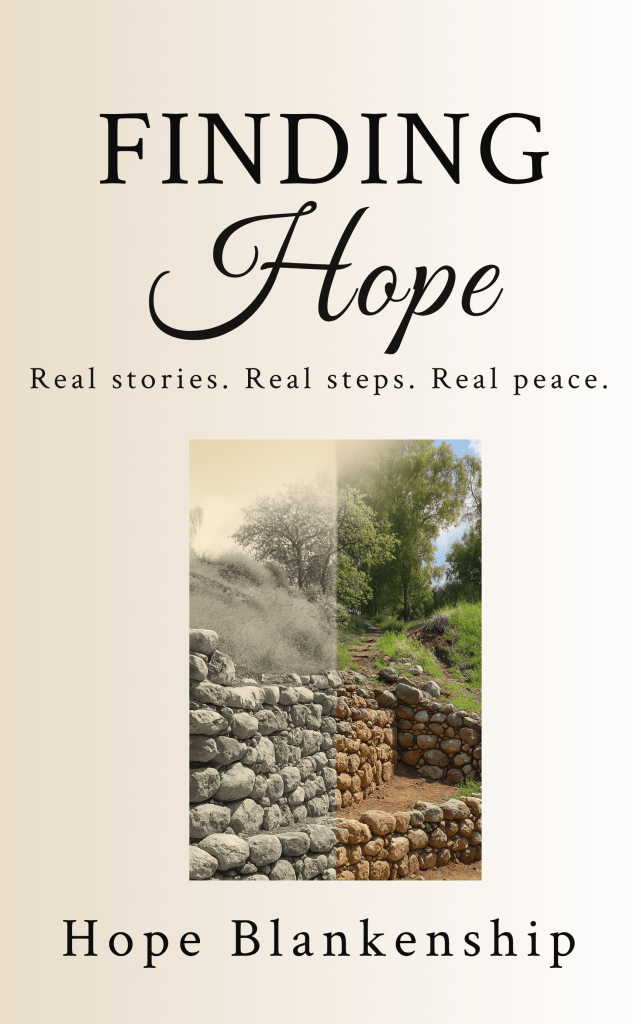
At first, those words were mine alone—tucked away in notebooks, revisited during quiet moments, or maybe shared over coffee with a young woman walking a road I had once traveled. But slowly, it became clear: God had more in mind for those pen strokes. What I thought were private reflections were seeds for something bigger. Finding Hope wasn’t planned—it was born out of obedience, healing, and the realization that my story could be someone else’s lifeline.

Recognizing pain and hurt from childhood—and choosing to face it.
Experiencing trauma as a college-aged girl who thought she had it all figured out.
Packing up a business and a family to move across the country with the military, starting over with nothing but faith and a fresh zip code.
Grieving. Searching for joy.
Falling in love with the one who would become my greatest earthly gift.
Staring down my worst fears and finding God in every valley and mountaintop.

This was my story to tell. And deep down, I knew someone out there needed to hear it—not for entertainment, but for encouragement.

My job isn’t to control the outcome. It’s simply to be obedient with the task He’s placed in front of me, and then to trust Him with the rest.

There’s nothing quite like putting your whole life on display for the world to read—and believing that God will use it in ways you couldn’t even dream of.

If I’m honest, this was a seven-year journey.
How fitting—and a little funny—that God chose the number seven. In Scripture, seven often symbolizes completeness and divine fulfillment. It marks something that has been made whole.

God led me through a six-year walk—not a sprint, not even a jog, but a slow, steady walk through healing, surrender, and growth. It wasn’t flashy or fast. It was faithful.

Then came the seventh year—a year of hiddenness, of deep revelation, and sacred stillness.

Not stillness in the world—life kept moving, as it always does. But stillness in my soul. A holy pause -Selah. A space to be quiet long enough to focus and write. Long enough to gather the memories, shape the chapters, edit with care, and pray through every page.

I remember sitting at dinner one night, holding this dream quietly between the Lord and me, when I finally looked at my husband and said,
“I think I’m supposed to write a book.”

Saying it out loud felt like a release. It was light. It was freeing. And it felt like the truest thing I had ever admitted about myself. As soon as the words left my mouth, something inside me settled.

Towards the end of 2024, I told him I had a goal: to attend a writing retreat in 2025. I didn’t know exactly what it would look like—I just knew I needed tools, space, and guidance for the journey ahead. Writing a book wasn’t going to be a quick task. It was going to take time, intention, and faith.

A little scared but even more excited, I released the goal to God and prayed for the door to open.

Two months later, on January 1, 2025, I opened my inbox and saw an email invitation to an Author Class Interest Meeting with Havilah Cunnington. I paused, prayed, and then signed up—still unsure where it would lead, but hopeful.

Never in a million years did I think that simple “yes” would lead to me completing my first full draft in just 16 weeks. I set a goal to publish by the fall and found myself surrounded by a group of incredible people from all over the country—each with the same dream I had carried in my heart for years.

Together, we learned how to outline, organize, and actually write the books God had placed in us. We encouraged each other, walked through doubt and writer’s block together, and celebrated every breakthrough—big and small.

The truth is,
📚 Only 3–5% of people who want to write a book ever begin.
📝 Of those, only 30% finish a full manuscript.
🚫 And 97% of those manuscripts never get published.

I’m now part of the small percentage who followed through—not because I had it all together, but because I finally stopped running from the calling and started trusting God with the process.

✨ Finding Hope is my story, but it’s also an invitation—for you to begin your own. I pray you’ll find hope in your story the same way I found hope in mine.

No pun intended.